
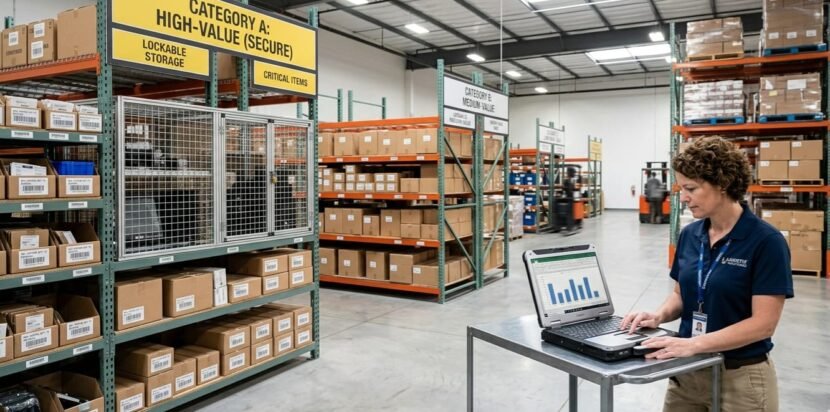
Introduction: Why Inventory Prioritization Matters
Many small and medium businesses store hundreds or even thousands of items in their warehouse. However, not all inventory items have the same value, usage frequency, or business impact. Treating every item equally often leads to poor control, overstocking, blocked capital, and stock shortages of critical materials.
ABC Analysis is a simple and powerful inventory management technique that helps businesses classify stock based on value and importance. It allows companies to focus more attention on high-value items while controlling medium and low-value items with appropriate effort.
For SMEs, ABC Analysis improves inventory control, reduces carrying costs, and supports smarter purchasing decisions.
What is ABC Analysis in Inventory Management?
ABC Analysis is a method of categorizing inventory into three groups:
- A Category Items – High-value items with lower quantity but major financial impact
- B Category Items – Medium-value items with moderate usage and impact
- C Category Items – Low-value items with higher quantity but lower financial impact
This system is based on the Pareto Principle, where a small percentage of items often contributes to a large percentage of inventory value.
By identifying which items matter most, businesses can allocate time, money, and control efforts more effectively.
Understanding A Category Items
A category items usually represent a small percentage of total inventory quantity but contribute the highest share of inventory value. These items are often critical raw materials, expensive components, or key finished goods.
Because of their value, these items require strict monitoring, accurate stock records, regular review, and controlled purchasing.
Businesses should maintain close management attention on A items to avoid stockouts, excess investment, or financial losses.
Understanding B Category Items
B category items fall in the middle range. They have moderate value and moderate usage frequency.
These items need balanced control systems. They should be reviewed regularly but may not need the same strict daily attention as A category items.
Proper planning for B items ensures smooth operations without unnecessary overstocking.
Understanding C Category Items
C category items are usually low-value items that may exist in high quantity. These can include consumables, low-cost spare parts, packaging materials, or common supplies.
Although individually low in value, they are still operationally important. Since these items are low cost, businesses can use simpler control methods and less frequent monitoring.
However, complete neglect of C items can still create operational disruption if they run out.
How to Perform ABC Analysis Step by Step
The first step is to prepare a complete list of inventory items with annual consumption value. This is calculated by multiplying annual usage quantity by unit cost.
Next, arrange all items in descending order based on annual value. Then classify them into A, B, and C categories.
Typically:
- A items = top 70% to 80% of inventory value
- B items = next 15% to 20% of value
- C items = remaining 5% to 10% of value
The exact percentage may vary based on business type.
Benefits of ABC Analysis for SMEs
ABC Analysis offers major benefits for growing businesses. It improves focus on important inventory, reduces excess stock, and improves working capital utilization.
It also helps businesses make better purchasing decisions, reduce carrying costs, and improve stock availability of critical items.
For SMEs with limited resources, ABC Analysis allows management to focus efforts where the financial impact is highest.
Common Mistakes While Using ABC Analysis
Some businesses make the mistake of doing ABC classification only once and never reviewing it again. As product demand and prices change, categories should also be reviewed periodically.
Another mistake is using only cost and ignoring criticality. Some low-cost items may still be operationally critical.
Businesses should combine ABC Analysis with operational judgment for best results.
Combining ABC Analysis with Better Warehouse Layout
ABC Analysis can also improve warehouse efficiency. A category items should be stored in secure and easily accessible locations. B items should be placed in organized mid-access zones, while C items can be stored in less prime locations.
This reduces picking time, improves productivity, and supports better warehouse layout planning.
Conclusion: Smarter Inventory Control Starts with Prioritization
ABC Analysis is one of the simplest and most effective tools in inventory management. It helps businesses understand which items need the most attention and where money is being tied up.
For SMEs, this method improves stock control, reduces waste, and strengthens working capital management. When used consistently, ABC Analysis becomes a strong foundation for efficient warehouse operations.
At Aarambh Business Consulting, we help businesses implement ABC Analysis, optimize inventory systems, and improve warehouse efficiency through practical solutions.
📞 Contact: 9689275533
🌐 www.aarambhconsulting.com